Designing a Mobile Diagnostic Tool for Resume Gaps
B2C • AI• Product Design • SaaS
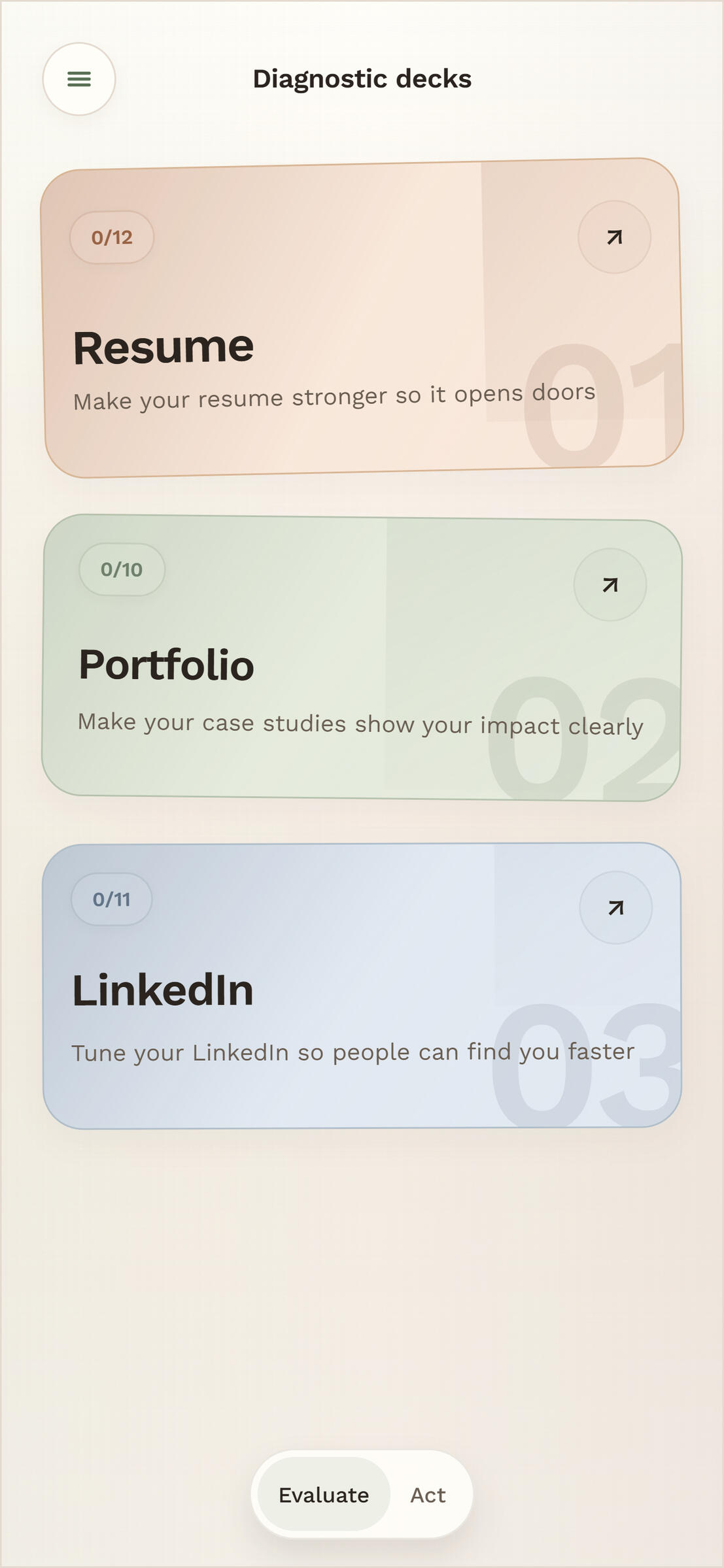
MAGI Decks is a mobile diagnostic product for UX and product designers in an active job search.
It helps users inspect their resume, portfolio, and LinkedIn profile through manually curated instructions instead of asking AI to rewrite or judge their materials.
Overview
MAGI Decks is a mobile job-search companion for UX designers and PMs who have been laid off. The app helps users understand whether they're market-ready to apply and keeps application activity quality-focused rather than volume-driven.
Services
Product Strategy
UX Architecture
Creative Direction
Role
Principal Designer
Plataform
Mobile
The Problem
Candidates can't figure out where they fail, whether it's the initial screen or the final round.
With this challenge in mind, I weighed 3 different solutions:
Option A
Broad career companion
Includes onboarding, planning, tracking, quizzes, recommendations, and multiple user flows.
Advantage: covers more career-support needs.
Risk: repeats the MAGI AI problem of too many flows and unclear focus.
Option B
AI analysis and recommendation tool
Upload or ingest materials, then have AI recommend what to fix.
Advantage: feels automated and familiar in the category.
Risk: moves judgment into a black box and turns career support back into output generation.
Option C (chosen)
Focused diagnostic deck system
User inspects their own materials through manually curated Cards.
Advantage: keeps judgment with the user, creates a finite flow, and makes the product easier to ship and polish.
Risk: sacrifices automation, breadth, and full career support.
Design Principles
AI did not decide what constituted useful career support or product values; all strategic boundaries were defined by me.
My Part
Defining the product premise and the evidence-based self-diagnostic framework.
Designing the UX/UI layout, visual direction, and the product vocabulary.
AI tools
Codex / Cursor: Used to generate plans and build the application.
Impeccable: Used to run automated critiques on visual hierarchy, accessibility, and category drift.
Diagnostic Card Framework
The effectiveness of the card decks relies on objective self-inspection.
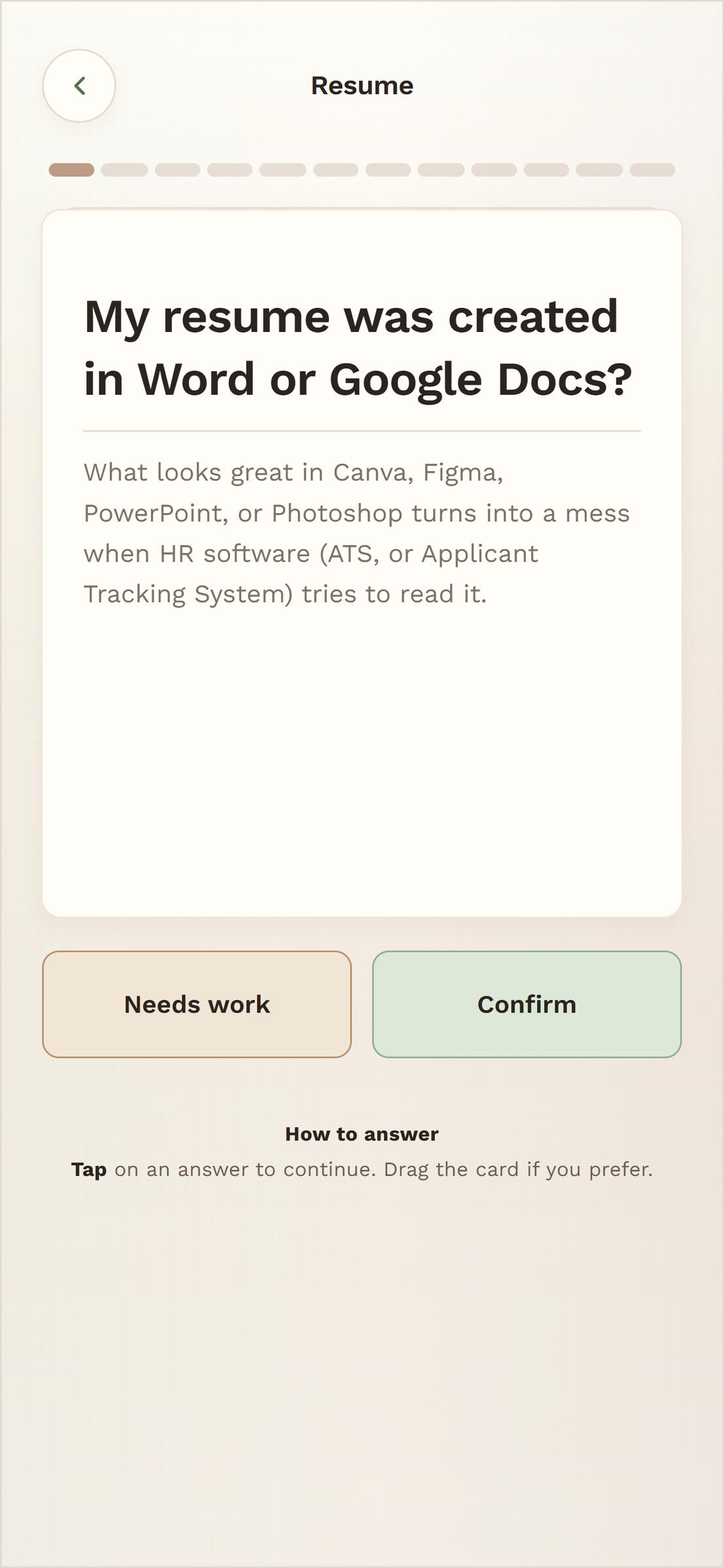
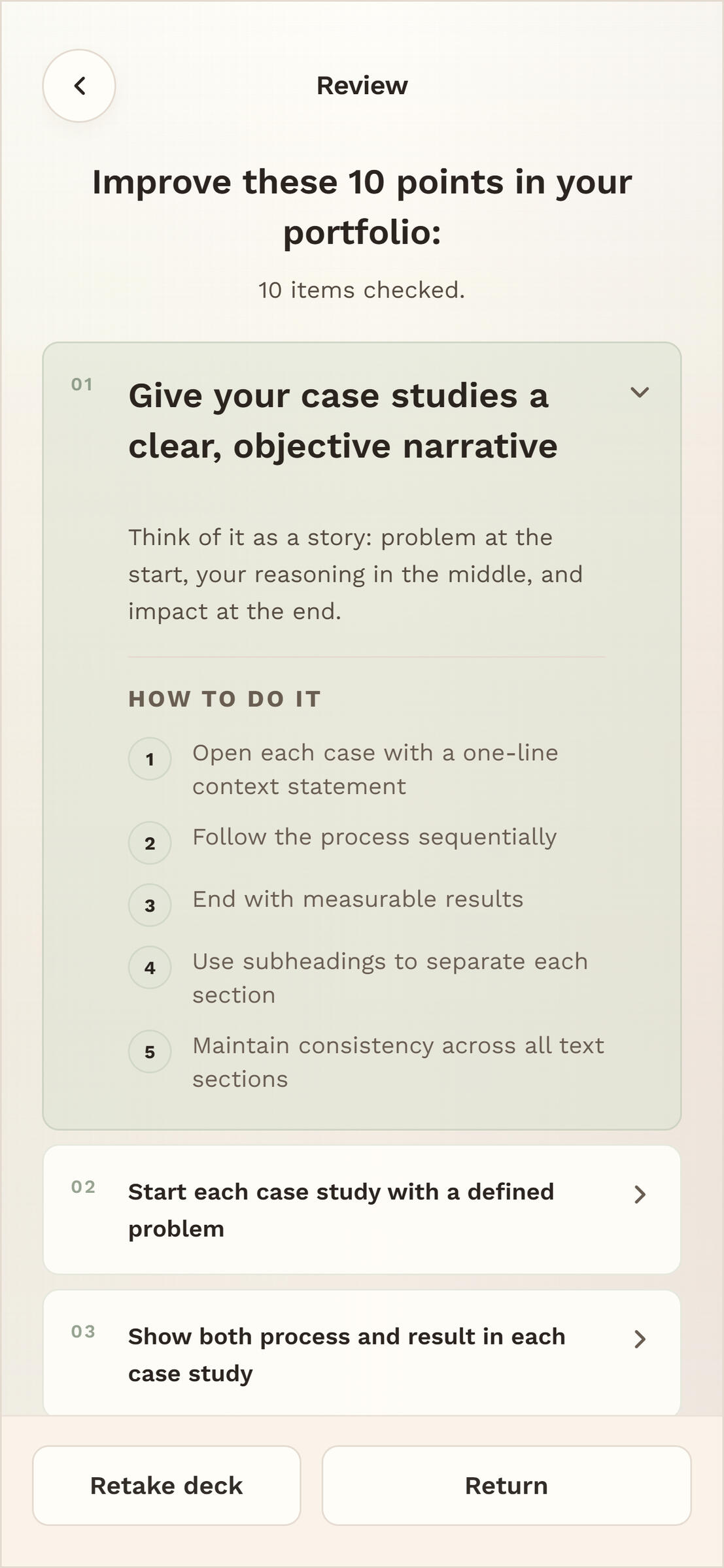
The app asks the user: "My resume was created in Word or Google Docs?" Below it, the card details why Canva/Figma layouts fail ATS scanners. The user self-inspects their file; if it fails, they flag the card to automatically send it to their Review Summary.
Retrospective
MAGI Decks demonstrates that reducing scope does not diminish ambition.
By embracing constraints, I built a highly precise diagnostic tool that respects user judgment, protects data privacy, and simplifies the job-search workflow when designers need clarity the most.
What Improved
- Product Clarity: The application is positioned clearly as a tactical instrument, not a career companion.
- UX Polish: The narrow scope left room to implement edge cases and accessibility features.
What Worsened
- Feature Sacrifices: The removal of AI ingestion and tracking systems means the app provides fewer conveniences, potentially disappointing users who expect automated rewrites.
- Validation Improvements: In future cycles, I would test the diagnostic cards with target users much earlier and establish a quantitative before/after log of UX critique changes to replace narrative claims with hard design metrics.